
Description
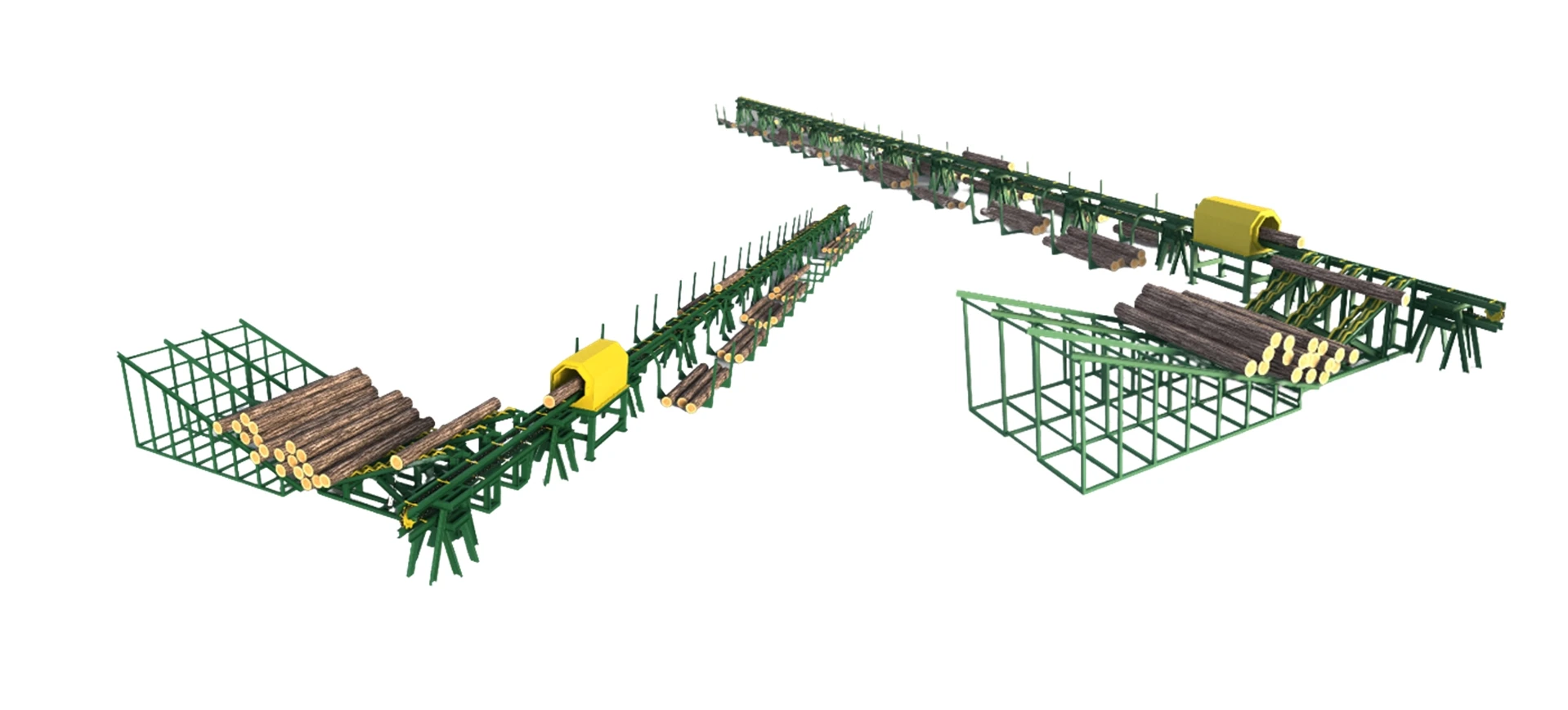
Log sorting lines, also referred to as log classification systems or automatic log sorting solutions, are industrial systems designed to organise, classify and route raw logs from the log yard to the primary cutting machines. These lines ensure a continuous, controlled and safe flow of logs, reducing manual handling and increasing overall sawmill efficiency.
Manufactured by Irmach and marketed under the Bartly brand, these log sorting and classification lines combine robust mechanical construction with modern electronic control, and can be fully integrated into existing timber processing equipment and infrastructure.
Robust Construction and Industrial Durability
Bartly log sorting lines are built with reinforced steel structures, high-strength profiles and industrial drives dimensioned for continuous operation. Each project is adapted to the needs of the sawmill, from simpler systems for small and medium plants to high-capacity configurations for large industrial sawmills.
They can be integrated with automatic debarkers, volumetric measurement systems, 3D scanners and other primary processing equipment, forming complete lines for log reception, sorting and feeding.
Modernisation of Existing Facilities and New Installations
These log classification lines are suitable both for new installations and for modernisation projects in existing sawmills. Their modular architecture allows reuse of existing equipment such as debarkers, conveyors and handling systems, reducing total investment and minimising downtime during installation.
Operational Versatility and Processing Capacity
Bartly solutions efficiently process logs with very different diameters, lengths and quality classes. They can perform automatic or semi-automatic classification according to customer-defined criteria such as diameter, length, volume, species and visual quality or defects.
Advanced configurations can include high-precision 3D scanners and automatic volumetric measurement by laser or cameras, increasing sorting accuracy, reducing human error and improving yield from the raw material.
Advanced Transport and Automated Routing
Log transport and positioning is carried out by longitudinal and transversal conveyors, motorised rollers and controlled rotation systems, which orient and align each log according to the requirements of the next process.
Logs can be routed to classified storage boxes, feeding channels by size or quality, dedicated discharge points or directly to subsequent cutting lines. The entire system can be monitored in real time from a control station with an intuitive graphical interface and production reporting tools.
Total Customisation and “Custom to Fit” Engineering
Each Bartly sorting line is engineered on a “custom to fit” basis, taking into account the mill layout, wood species processed (softwood, hardwood, tropical), expected production volumes and the desired level of automation. This approach ensures efficient use of space and seamless integration into existing workflows.
Irmach manages all project stages: feasibility and concept studies, detailed engineering, fabrication, on-site assembly, commissioning, performance testing and training of operating and maintenance teams.
Competitive Advantages of Bartly Log Sorting Lines
- Optimised flow from log reception to saw feeding
- Automatic classification using multiple configurable technical criteria
- Robust industrial construction for continuous operation in demanding environments
- Integration with debarking systems and other existing processing equipment
- Ability to handle a wide range of log sizes without frequent reconfiguration
- Optional 3D scanning for high-precision automatic volumetric measurement
- Significant reduction in labour for manual sorting and log handling
- Improved safety by reducing hazardous manual operations
- Modular and scalable architecture for future expansion
- Reuse of existing equipment in modernisation projects
- Centralised electronic control with real-time monitoring
- Minimised downtime during installation on existing lines
Industrial Applications of Log Sorting Lines
- Automated reception and organisation of logs in log yards
- Dimension and quality classification before feeding main saws
- Integration with debarking systems for continuous log preparation
- Automated and synchronised feeding of multiple parallel cutting lines
- High-capacity sawmills processing large annual volumes
- Integrated operations combining debarking, sorting and automatic feeding
- Modernisation of traditional sawmills to increase productivity and competitiveness
- Processing centres for tropical timber or high-value hardwoods
Technical Components and Functionalities
Depending on the project, Bartly sorting lines may include: heavy-duty chain conveyors, synchronised motorised rollers, hydraulic or pneumatic positioning systems, 3D laser scanners, vision cameras for defect detection, controlled rotation devices, programmable automatic diverters, integrated weighing systems and management software with touchscreen interface and detailed production reports.
Made in Portugal and Irmach Technical Support
Irmach designs and manufactures Bartly sorting lines in Portugal, focusing on automation, productivity and reliability in industrial environments. Selected components and appropriate mechanical sizing ensure stable operation, low maintenance costs and consistent performance over time.
Technical support includes remote assistance, fast supply of critical spare parts, preventive maintenance plans, control software updates, performance optimisation services and initial and ongoing training for customer teams.
Frequently Asked Questions about Bartly Log Sorting Lines
How does the automatic log sorting and classification process work?
Logs are received in the yard and transported by chains or rollers to the measuring and sorting zone. Sensors (laser, cameras or weighing systems) identify diameter, length, estimated volume and, when applicable, visual quality. Based on pre-set criteria, the control system assigns a class to each log and activates diverters, pushers or directional rollers to route it automatically to the correct box, feeding channel or processing line.
Can the sorting line be integrated with existing debarkers?
Yes. Bartly lines are often designed to feed existing ring, knife or hydraulic debarkers, making use of previously installed equipment and adding the automation required for sorting and routing. This reduces investment and allows modernisation without replacing functional machines. Irmach performs integration studies to ensure mechanical compatibility and synchronised operation.
What types of classification criteria can be used?
Criteria are fully configurable and can include diameter (with defined ranges), length classes, estimated volume, wood species and visual quality indicators such as knots, curvature or surface defects. Several criteria can be combined and multiple classes and destinations can be managed simultaneously.
What log dimensions can be processed?
Each line is dimensioned individually, but in general Bartly solutions cover small-diameter logs up to large-dimension timber, with a wide range of lengths. Transport speeds, forces and measuring times are adjusted so that logs of different sizes are handled safely and measured accurately.
How long does it take to install a complete sorting line?
Installation time depends on the size and complexity of the project. Basic systems can be installed in a few weeks, while large high-capacity lines with several integrated modules may require several months from civil works to final commissioning. Site preparation (foundations, power supply, layout) has a strong impact on total time. Irmach works with the customer to plan phased installation and minimise production stoppages.
What is the typical processing capacity of these lines?
Capacity varies with configuration, log size and level of automation. Basic lines are suitable for small and medium sawmills, while fully automated high-capacity lines are designed for large industrial operations with multiple shifts. Each Bartly project is sized to match the required production volume and to support future growth.
What maintenance is required for these lines?
Maintenance is mainly preventive: regular lubrication of chains, rollers and moving parts, cleaning of optical sensors and cameras, checking chain wear and tension, verifying mechanical alignments and inspecting hydraulic or pneumatic systems (oil levels, pressures, filters). The robust design and use of high-quality industrial components reduce corrective interventions and contribute to high availability.
Does the system allow traceability and production reporting?
Yes. Advanced systems can record data for each processed log: time of entry, measured dimensions, assigned class, routing destination and calculated volume. This information can be used to generate reports on processed volumes, class distribution, efficiency, downtime and trends, supporting production planning, cost control and capacity analysis. Real-time dashboards and historical data are available through the control interface.
What is the expected return on investment for an automatic sorting line?
Return on investment depends on the scale and current level of automation, but typically comes from reduced labour in manual sorting, higher throughput, better raw material yield, fewer damaged logs, fewer accidents and better stock control. In many cases, the combined effect of these gains allows the investment to be recovered within a relatively short period.
Does Irmach provide training for operation and maintenance?
Yes. Training covers system operation, use of the control interface, configuration and adjustment of classification parameters, safe start-up and shutdown procedures, basic preventive maintenance and troubleshooting of common issues. Training can be provided for operators, supervisors and maintenance teams, and is supported by detailed technical manuals and ongoing technical support after commissioning.